
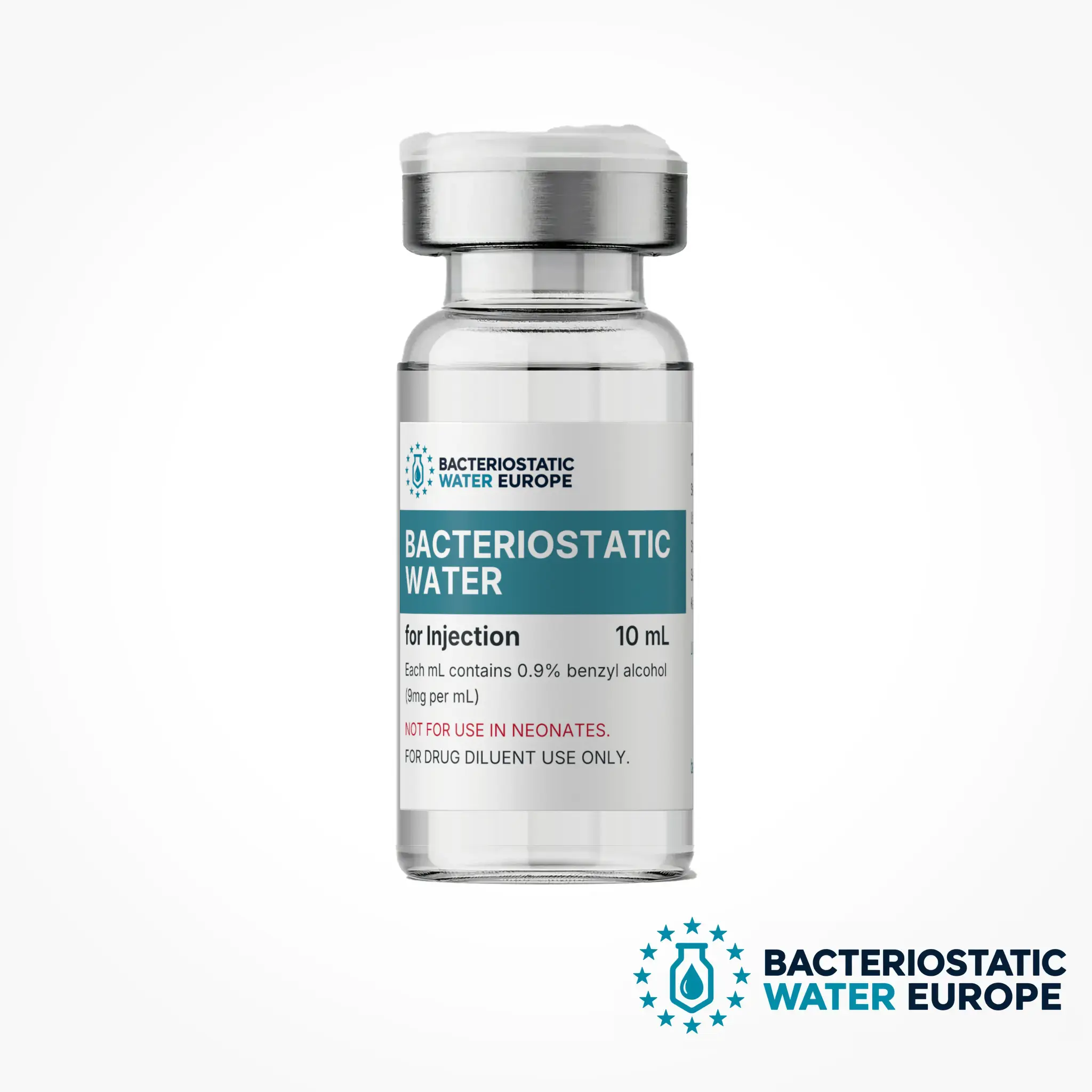
Bacteriostatic water 10ml is a sterile, multi-dose diluent preserved with 0.9% benzyl alcohol, sized for laboratories running regular reconstitution work across multiple sessions. This page covers what’s included, full technical specifications, and how the 10ml size compares to our 3ml and 30ml vials. All products described on this page are supplied for laboratory and research use only, not for human or veterinary use, diagnostic use, or any form of consumption.
What Is Bacteriostatic Water?
Bacteriostatic water is water for injection (WFI) preserved with 0.9% benzyl alcohol, which inhibits bacterial growth so a vial can be accessed more than once without being discarded after a single draw. It’s the standard diluent used across research laboratories for reconstituting lyophilised (freeze-dried) compounds into solution.
Unlike single-draw sterile water for injection (SWFI), the benzyl alcohol preservative in bacteriostatic water is what allows a multi-dose vial to remain viable for repeated use in a laboratory setting, provided aseptic technique is used for every draw.
This 10ml bacteriostatic water is supplied strictly for in-vitro laboratory and research use. It is not manufactured, labelled, or supplied for human or animal administration, diagnostic use, or any clinical purpose.
What’s Included in The 10ml Bac Water?
- Vial size: 10ml
- Physical form: sterile liquid, clear and colourless
- Composition: Water for Injection with 0.9% w/v benzyl alcohol preservative
- Included documentation: batch-specific Certificate of Analysis (COA) available on request
Technical Specifications of The Bacteriostatic Water 10ml
| Specification | Details |
|---|---|
| Diluent | Water for Injection (WFI) |
| Product | Bacteriostatic Water |
| Preservative | Benzyl alcohol, 0.9% (9 mg/mL) |
| Preservative CAS Number | 100-51-6 |
| Vial Volume | 10ml |
| Container | Glass Vial |
| Form | Sterile liquid |
| Use classification | Laboratory and research use |
| Appearance | Clear, colourless liquid |
| Pyrogen status | Non-Pyrogenic |
Who This Bac Water 10ml Size Is For?
The 10ml vial is the right choice for labs and researchers who:
- Run multiple reconstitutions across a working week and want to avoid re-ordering a 3ml vial each time
- Support more than one active research protocol from the same diluent stock
- Want a balance between per-ml cost efficiency and manageable open-vial inventory
- Are moving from small-scale testing (3ml) into a more established, repeatable workflow
For very small, single-use projects, the 3ml size may involve less waste; for high-throughput or multi-user labs, the 30ml size is typically more cost-efficient per ml, see the comparison below.
| Size | Best For | Relative Cost per ml |
|---|---|---|
| 3ml | Small-scale or single-project research, minimal open-vial wastage | Higher |
| 10ml | Regular lab use, multiple reconstitutions | Medium |
| 30ml | High-throughput or multi-user laboratory settings | Lower |
Need a larger supply? See our 3ml bacteriostatic water and 30ml bacteriostatic water pages for multi-dose and high-volume options.
How Benzyl Alcohol Preservation Works
The 0.9% w/v benzyl alcohol in this vial acts as an antimicrobial preservative, disrupting the cell membranes of bacteria that may be introduced each time the vial is punctured and slowing their growth between draws. That concentration matches the level specified in the USP monograph for bacteriostatic water for injection, selected because it controls a broad range of common contaminants without shifting the solution’s pH or clarity.
“Bacteriostatic” describes what the preservative does, it inhibits further bacterial growth once the vial is opened, rather than making every subsequent draw sterile by itself. Because of that, aseptic technique (a clean needle, a disinfected stopper, minimal air exposure) still matters on each of the vial’s multiple uses, not just the first.
Research Applications
This 10ml size is built around repeat use: labs typically draw it down across several reconstitutions of lyophilised (freeze-dried) research compounds over a working week, rather than using the whole vial in one session. It suits protocols that run more than one active reconstitution from the same diluent stock, or that need a consistent, preserved dilution medium available on the bench across multiple sessions.
It’s also a practical size for preparing dilution series or assay components where a moderate, ongoing supply of preserved water is more convenient than repeatedly opening fresh small vials.
Storage & Handling
Store unopened vials at controlled room temperature (20–25°C / 68–77°F), away from direct light. Once a vial has been punctured, use aseptic technique for every subsequent draw.
Standard laboratory practice for benzyl alcohol-preserved multi-dose diluents is to limit the in-use period (commonly 28 days from first puncture) to reduce contamination risk, confirm the exact interval against your own laboratory SOP. Do not use if the solution appears cloudy, discoloured, or contains visible particulate.
Certificate of Analysis & Quality Assurance
Each batch is manufactured under controlled, sterile conditions and tested for sterility, endotoxin/pyrogen levels, pH, and benzyl alcohol concentration prior to release. A batch-specific Certificate of Analysis (COA) is available for this product on request, confirming purity, sterility testing, and preservative content for full traceability.
Frequently Asked Questions
What is 10ml bacteriostatic water used for?
In a laboratory setting, it’s used as a diluent to reconstitute lyophilised research compounds into a liquid solution across multiple sessions. It is not intended for human or animal use.
How many reconstitutions can I get from a 10ml vial?
This depends on the dilution volume used per compound in your protocol. The 10ml size is generally suited to labs running several reconstitutions rather than a single one-off project.
What’s the difference between bacteriostatic water and sterile water?
Bacteriostatic water contains 0.9% benzyl alcohol, which inhibits bacterial growth and allows a vial to be used more than once. Sterile (non-bacteriostatic) water for injection has no preservative and is intended for a single draw.
How long does an opened 10ml vial last?
Once punctured, standard practice for benzyl alcohol-preserved multi-dose diluents is to use the vial within roughly 28 days, provided it is stored correctly and accessed aseptically each time. Always follow your lab’s own SOP.
How should bacteriostatic water be stored?
Store unopened vials at controlled room temperature, away from direct light, and inspect the solution before each use for clarity and the absence of particulate.
Is this bacteriostatic water sterile?
Yes, it is sterile and aseptically filled, with each batch tested prior to release.
What concentration of benzyl alcohol does this product contain?
0.9% w/v benzyl alcohol, in line with standard bacteriostatic water formulations (CAS 100-51-6).
Where can I find the Certificate of Analysis for this batch?
A batch-specific COA is available on request, contact us with your order or batch number.
Scientific References
- Bacteriostatic Water for Injection, USP, FDA-approved prescribing label confirming the 0.9% benzyl alcohol preservative standard for multi-dose bacteriostatic water. DailyMed / U.S. National Library of Medicine. https://dailymed.nlm.nih.gov/dailymed/fda/fdaDrugXsl.cfm?setid=87d6e9dc-fe3b-4593-ac9a-d7493d1959c7