
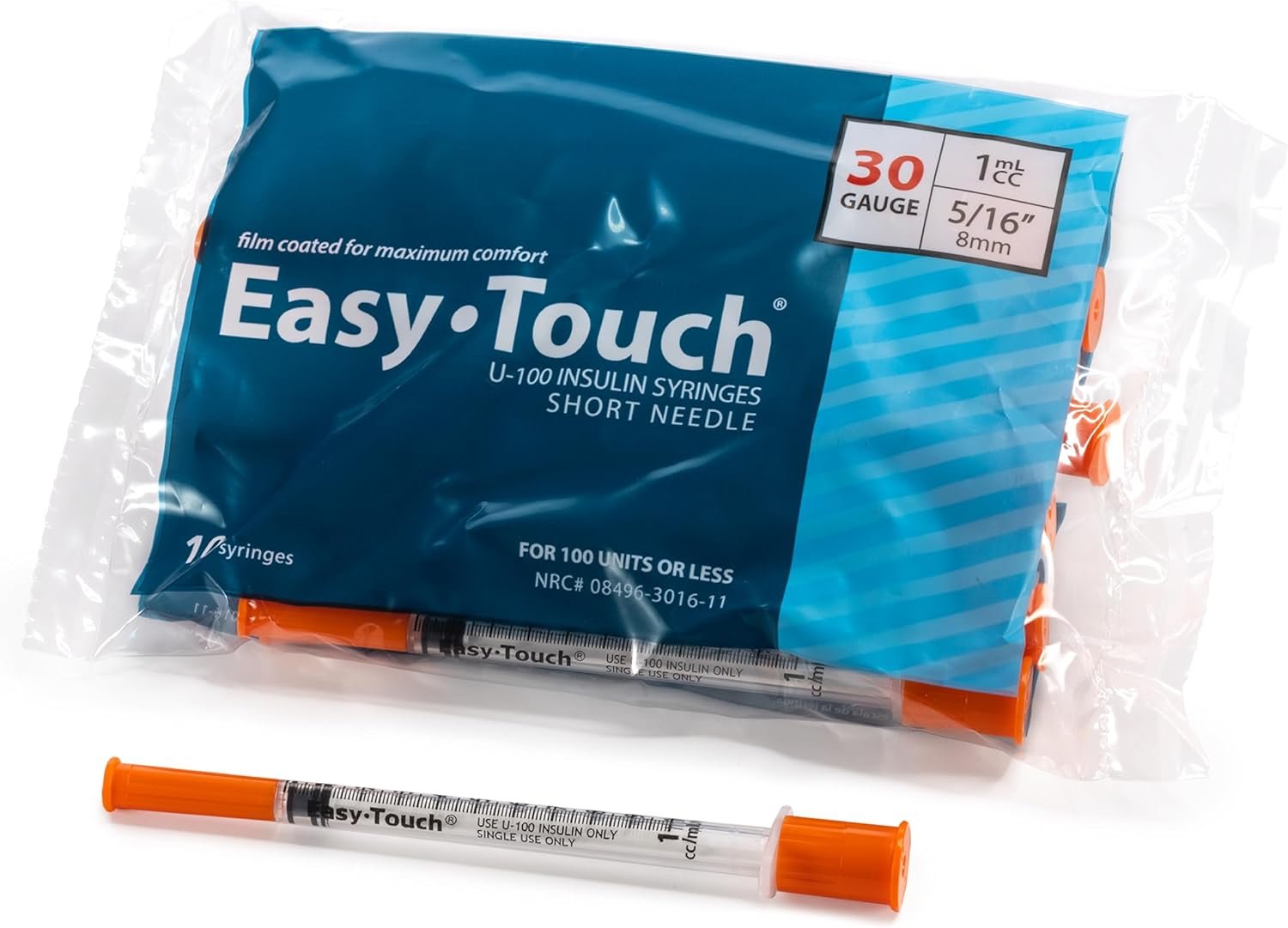
What Are Insulin Syringes?
Insulin syringes are small-capacity syringes, typically graduated in fine 1-unit or 0.5-unit increments, originally designed for measuring very small liquid volumes with precision. Their narrow-gauge needle and low dead-space barrel make them a common choice in laboratory settings for accurately drawing and transferring small volumes of reconstituted research solutions, where measurement precision and minimal residual loss matter.
If you’re buying insulin syringes in the UK for laboratory use, the specification that matters most is dead-space design, the amount of solution left unusable in the needle and barrel after each draw, alongside needle gauge and barrel capacity, all detailed below for this product.
What’s Included?
- Pack size: 10 individually sealed syringes
- Needle length: 5/16 inch
- Included documentation: batch sterility information available on request
Technical Specifications of The 10 pack insulin syringes
| Specification | 0.5cc Option | 1cc Option |
|---|---|---|
| Brand | EasyTouch | EasyTouch |
| Product type | Insulin syringe | Insulin syringe |
| Pack quantity | 10 syringes | 10 syringes |
| Capacity | 0.5cc (0.5mL) | 1cc (1mL) |
| Gauge | 30G | 31G |
| Needle length | 5/16 inch | 5/16 inch |
| Pack format | 10-pack | 10-pack |
Who This Product Is Insulin Syringes For?
- Labs transferring or measuring small volumes of reconstituted research solutions
- Researchers who need to minimise residual (dead-space) loss across repeat measurements
- Anyone needing fine-gauge, low-waste measuring tools for small-batch laboratory work
Low Dead-Space Design & Measurement Accuracy
“Dead space” refers to the small volume of fluid that remains trapped in a syringe’s needle and barrel after the plunger is fully depressed — fluid that is drawn up but never actually delivered. A peer-reviewed quantification study published in PLOS ONE measured this residual volume across a range of standard needle and syringe combinations and found it varies meaningfully by design, which is why “low dead-space” syringes are specified in settings where minimising wasted volume and improving measurement consistency both matter.
Syringe manufacturing and dimensional tolerances for devices like these are governed by ISO 7886-1, the international standard for sterile single-use hypodermic syringes for manual use, which is a useful reference point when comparing specifications across suppliers.
Needle Gauge & Precision in Small-Volume Work
Needle gauge is the other variable that determines how precisely a small volume can be drawn and dispensed. A finer gauge (a higher number, such as 29G or 30G) produces a narrower needle bore, which slows the flow rate slightly but gives finer control over exactly where the plunger stops, useful when a protocol calls for measuring in small, consistent increments rather than a single bulk transfer.
Fine-gauge, low dead-space needles are typically paired with a fine-increment barrel (1-unit or 0.5-unit graduations) for exactly this reason: the combination is what allows small, repeatable volumes to be measured consistently across many draws from the same stock solution, rather than each draw introducing its own margin of error.
Research Applications
In a laboratory setting, this 10-pack is typically used to draw and transfer small, precise volumes of reconstituted research solutions between vials, into assay preparations, or onto other laboratory equipment, anywhere a bulk syringe or pipette would be imprecise at the volumes involved. The low dead-space design is particularly relevant when working with a limited stock solution, since it reduces how much is lost, unusable, in the syringe itself after each transfer.
Because each syringe is single-use and individually sealed, a 10-pack also suits protocols that call for a fresh, sterile syringe at each step or across a short run of repeat measurements, without needing to source syringes one at a time.
Storage & Handling
Store sealed syringes at room temperature in their original packaging until use. Each syringe is intended for single use only, do not reuse or resterilise. Dispose of used syringes as sharps waste in accordance with your laboratory’s standard operating procedures.
Certificate of Analysis & Sterility Assurance
Each batch is manufactured to ISO 7886-1 dimensional and quality specifications and sterilised using ethylene oxide (EO), with residual EO levels tested prior to release. Batch-specific sterility documentation is available for this product on request.
Frequently Asked Questions
Where can I buy insulin syringes in the UK?
This 10-pack is available to order on this page, with fast UK dispatch. Supply is for laboratory and research use only.
What is a low dead-space syringe?
It’s a syringe designed to minimise the residual fluid volume left in the needle and barrel after the plunger is fully depressed, reducing waste and improving measurement consistency across repeat draws.
What needle gauge do these insulin syringes use?
The 0.5cc option uses a 30G needle and the 1cc option uses a 31G needle, both 5/16 inch in length.
Are these insulin syringes sterile and single-use?
Yes, each syringe is individually sealed, sterilised, and intended for single use only.
Can I reuse an insulin syringe?
No. These are single-use devices; reusing a syringe compromises sterility and measurement accuracy.
How many units does the barrel hold?
The 0.5cc option holds 0.5ml (50 units) and the 1cc option holds 1ml (100 units).
Are these syringes suitable for laboratory reconstitution work?
Yes, the fine gauge and low dead-space design make them well suited to precisely measuring and transferring small volumes of reconstituted research solutions.
Is this product for human use?
No. These insulin syringes are supplied strictly for laboratory and research use, not for human or animal injection, medical use, or any clinical application.
Scientific References
- Quantification of dead space in needles and syringes, peer-reviewed measurement study of residual fluid volumes across standard needle/syringe combinations. PLOS ONE / PubMed Central. https://pmc.ncbi.nlm.nih.gov/articles/PMC8604420/
- ISO 7886-1, Sterile hypodermic syringes for single use, Part 1: Syringes for manual use (international manufacturing and quality standard). International Organization for Standardization. https://www.iso.org/standard/64790.html